
Home
08 8132 6400
admin@i2advisory.com.au
  • Home
  • Our Firm
    • David Inglis (Consultant)
    • Geoff Inglis (Consultant)
    • Craig Madden
    • Jonathon Morphett
    • Kevin Johnson
    • Virginia Fakkas
    • Lauren Allen
    • Craig Muchamore
    • Don Sampson
  • Key Services
    • Business Advisory
    • Taxation
    • SMSF
    • Bookkeeping
  • Industries
    • Agribusiness
    • Health
    • High Net Worth Individuals & Private Investors
    • Hospitality & Tourism
    • Manufacturing
    • Not For Profit
    • Professional Services
    • Property & Construction
    • Retail & Wholesale
    • Retirement Villages
    • Transport & Distribution
  • Financial Planning
  • Blog
  • Resources
    • Business Administration
    • Business Incentives
    • COVID-19
    • Superannuation
    • Taxation
  • Payments
  • Contact Us

Blog

Individual or corporate trustee for your SMSF?

14 November 2020

When establishing a self managed superannuation fund (SMSF), one central decision to be made early on is if the trustee structure is to consist of individual trustees or a corporate trustee. Between these choices, you can have up to four individual trustees, or one company that acts as trustee (with that incorporated body having up to four directors).

There are differences between these two structures, which can matter depending on your circumstances and outlook on effective retirement savings. The decisions to be made when choosing between the two choices relate to member/trustee requirements, some costs, how assets are to be owned, possibly penalties, and ultimately any succession considerations.

Continue reading “Individual or corporate trustee for your SMSF?” →

The realities of insuring against cyber crime

17 October 2020

Think your business is too small or that your data and information isn’t important enough to be targeted by hackers? Think again.

Much of our communication, be it personal or businesses-related, has increasingly moved online in the last two decades, and continues to do so, especially in these recent times of COVID-19 with nearly everyone doing business exclusively online. Every day, thousands of pieces of information are transmitted via email, text, Messenger, WhatsApp, LinkedIn, social media and so on.

Yet while we’ve launched with a vengeance into the online world, whether by choice or of COVID-necessity, how many of us have kept pace with adequate cyber protections and insurances? Every day, we see individuals and businesses being targeted by cyber criminals. And it’s not just the big end of town in the crosshairs — plenty of smaller practices fall victim to cyber crime.

Cyber insurance can be regarded as business-critical insurance because statistics show that the likelihood of a claim occurring within a cyber insurance policy is now as high, if not higher, than making a claim against your business insurance or PI insurance.

Yet not all insurance policies are the same, and so businesses need to understand exactly what they are and are not covered for. At a minimum, a cyber policy should provide a 24/7 breach response service (including IT forensic services), breach response management, credit monitoring, public relations crisis management, civil and regulatory defence costs and penalties, cyber extortion costs, business interruption cover and cyber terrorism.

Continue reading “The realities of insuring against cyber crime” →

JobKeeper Extension – Am I eligible?

29 September 2020

The first round of the JobKeeper subsidy ended on 27 September 2020. For those that have been eligible to receive it, it has been a welcome boost to help businesses through what has been an uncertain time.

However – where to now?

With the extension of the JobKeeper rules passed into legislation (colloquially dubbed “JobKeeper 2.0”), businesses need to consider their eligibility under these new rules. This includes businesses who were previously ineligible that may now be eligible, as well as those businesses who have been receiving JobKeeper payments to date.

JobKeeper 2.0 vs JobKeeper 1.0

What remains the same?

  • Access for businesses, not for profits, eligible business participants and religious institutions/practitioners
  • Decline in turnover percentage thresholds (i.e. 15%, 30% or 50%)
  • The need to satisfy wage condition rules
  • Monthly reporting of turnover to the ATO
  • Integrity rules
  • The meaning of eligible employee and eligible business participant
  • The rule preventing more than one  employer claiming in respect of the same employee
  • The enrolment process

What changes?

  • The test periods and method of calculation
  • Modifications to the ‘Decline in Turnover Test’
  • Tiered rates of payments
    • 28 September 2020 to 3 January 2021 (Extension 1)
      • Tier 1 = $1,200 per fortnight
      • Tier 2 = $750 per fortnight
    • 4 January 2021 to 28 March 2021 (Extension 2)
      • Tier 1 = $1,000 per fortnight
      • Tier 2 = $650 per fortnight
    • ‘Tier 1’ applies to eligible employees who worked 80 or more hours in the 4 weeks of the pay periods before 1 March 2020 or 1 July 2020 OR eligible business participants who worked 80 or more hours in the 4 weeks of the pay periods before 1 March 2020
    • ‘Tier 2’ applies to all other eligible employees and eligible business participants

What do I need to do?

  • Assess eligibility – are you still (or now) eligible? You will need to enrol if you are eligible.
  • Does your business meet the relevant decline in turnover test for the September Quarter?
  • Determine eligible employees and the payment ‘Tier level’ they are eligible for based on their reference period
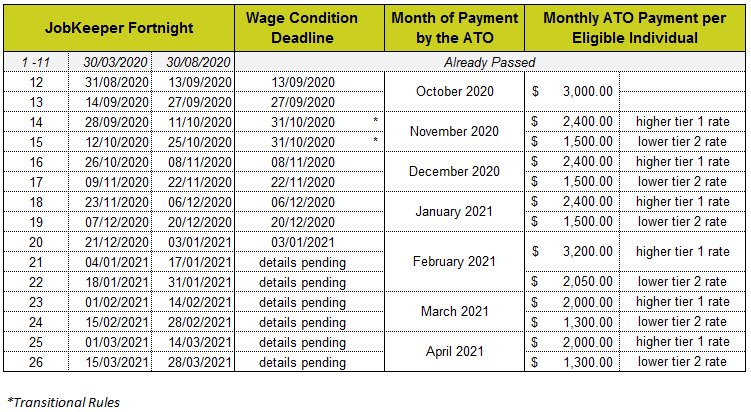
  • You have until 31 October 2020 to meet the wage condition (i.e. top-up employees if required) for fortnights ending in October for eligible employees – see Fig 1
  • If eligible, you will need to ensure the monthly declarations are lodged with the ATO before the 14th day after the end of each month to receive your payment

What do I need to do in my payroll software?

  • Identify the eligible employees and enrol them as JobKeeper participants (only if new to the JobKeeper scheme)
  • Assign a Tier 1 or Tier 2 payment rate to each eligible employee
  • For more guidance click your accounting software link below
    • Xero
    • MYOB AccountRight
    • MYOB Essentials
  • For those businesses no longer eligible for JobKeeper payments or for individual employees which may no longer be eligible under the JobKeeper extension, you will need to process this in your relevant software by ‘stopping’ JobKeeper payments
  • Without doing the above as it applies, Single Touch Payroll filing may be rejected

Fig 1 – JobKeeper Fortnight Calendar

We are happy to assist with any of the above from assessing your eligibility as an employer and identifying the eligible employees and/or business participants that you can receive payments for.

If we can assist with the above or any other matters, please do not hesitate to contact us at admin@nulli2advisory.com.au or 08 8132 6400.
DISCLAIMER: This summary is for general use only and should not be relied upon or taken to constitute advice. Further, it is based on available information which is subject to change.

COVID-19 and residential rental property claims

30 August 2020

Many residential rental property owners have had their rental income affected by COVID-19. As a result of this income year not being business as usual, the ATO has provided answers to some typical scenarios that may crop up in this area for tax time.

Q: If tenants are not paying their full rent of have temporarily stopped paying rent as their income has been affected due to COVID-19, can a property owner still claim deductions on their rental property expenses?

A: Yes. If tenants are not meeting their payment obligations under the lease agreement due to COVID-19 and you continue to incur normal expenses on your property, then you will still be able to claim these expenses in your tax return.

Continue reading “COVID-19 and residential rental property claims” →

JobKeeper Update – Change to Eligible Employee Start Date

18 August 2020

It was much quicker than we anticipated, but the ATO have now released guidance on changes to the current JobKeeper program relating to ‘employee eligible dates’ which needs urgent consideration from employers.

From the 3rd of August, the reference date for an employee’s eligibility to JobKeeper payments changes from 1st of March to 1st of July 2020. Employers now need to consider the eligibility of employees who were employed at 1st July 2020.

There is no change for existing employees who were already eligible for the JobKeeper program, nor is there any change to an employer’s existing eligibility to the JobKeeper program.

Which employees may now be eligible?

For the JobKeeper fortnight beginning 3rd August 2020, there are a number of employees who may now be eligible as at the 1st July 2020 including;

  • New staff who started after 1st March 2020
  • Casuals who have, since 1st March 2020, met the definition of long term casual employees
  • Employees who were not eligible due to their age
  • Employees who may hold an eligible visa

Other circumstances to review and consider 

  • Employees who may have nominated for JobKeeper with another employer, under limited circumstances can re-nominate with a new employer as long as they have ceased their employment with the original employer between 1st March 2020 and 1st July 2020
  • An employer who was previously ineligible for JobKeeper, still has the ability to test their JobKeeper eligibility in the months of August and September. Eligible employees may include employees who started prior to 1st July 2020

Action Items 

  • Review your existing employees and business participants who were not previously eligible for JobKeeper to determine if they are now eligible
  • Provide those employees with an employee nomination form ASAP. The ATO has updated this form and you can find it here
  • Calculate any shortfalls required for employees whose pay is required to be ‘topped up’ to $1,500 per fortnight. Note: the full time and part-time rates only apply for JobKeeper 2.0 which begins 28th September 2020
  • Payment of any top up is required by 31st August 2020 in respect of the JobKeeper fortnights 3rd August – 16th August 2020 and 17th August – 30th August 2020

‘One in – All in’ principle still applies 

  • Remember the ‘One in – All in’ principle continues to apply
  • If you are already a participant in JobKeeper you need to provide employee nomination forms to those employees who may now be eligible
  • You do not have discretion to exclude employees

If we can assist with the above or any other matters, please do not hesitate to contact us at admin@nulli2advisory.com.au or 08 8132 6400.

COVID-19 – JobKeeper program update

14 August 2020

JobKeeper 1.0 Reminder

For those currently registered in the JobKeeper program

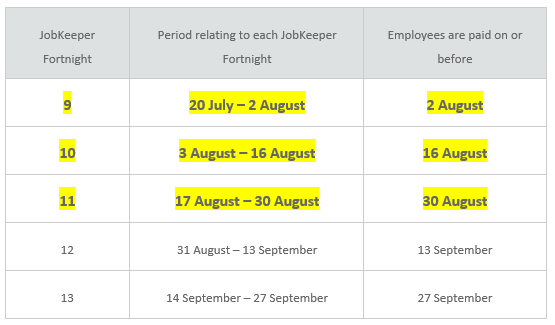
For the month of August 2020 please be mindful that there are 3 fortnights for the purposes of the JobKeeper program. What does this mean?

For the month of August, eligible employees are required to each be paid at least $1,500 in each of the 3 fortnights that fall in the month of August (a total of at least $4,500 Gross Wages).

Please see below the JobKeeper fortnights affecting the month of August through to the end of September under the original JobKeeper program.

JobKeeper fortnights (up until 27 September)

For those not currently registered in the JobKeeper program

To claim JobKeeper payments for the August JobKeeper fortnights, you must enrol for JobKeeper and identify your eligible employees by 31 August 2020.

If you require assistance assessing your eligibility to these payments and and/or your business has become eligible for the month of August, please contact this office.

JobKeeper 2.0 Update

There are many questions regarding the ins and outs of JobKeeper 2.0. We are awaiting further commentary from the Australian Taxation Office (“ATO”) with parliament due to next meet on the 24 August 2020 to discuss this further. Hopefully we will see further information in the coming weeks.

Further changes were announced on 7 August 2020 to adjust the reference date for an employee’s eligibility and make it easier for organisations to access JobKeeper payments in light of the further restrictions in Victoria. From 3 August 2020, the relevant date for employment will move from 1 March to 1 July 2020.

Some of the implications of these changes are;

  • If you have had new staff which started after 1st March 2020 but prior 1st July 2020, who were ineligible for the original JobKeeper 1.0, may now be eligible for JobKeeper;
  • If you have long-term casuals whose 12 month anniversary of employment fell between 1st March 2020 and 1st July 2020 may now be eligible for JobKeeper;

The ATO have yet to release guidance regarding these points and the implications for our clients.

At this early stage we recommend clients;

  • Collate details of their employees, who were not previously eligible at 1st March 2020, for eligibility as at 1st July 2020;
  • Collate employees hours of work in the four weeks prior to 1st March 2020 and 1st July 2020;
  • In mid to late September 2020 we encourage clients have their books up to date. It maybe a tight turnaround between determining eligibility, enrolment and paying employees, as the first JobKeeper fortnight under JobKeeper 2.0 starts 28th September 2020.

A very useful infographic, which we would recommend reviewing, of the extended JobKeeper program can be found on the Chartered Accountants website here.

If we can assist with the above or any other matters, please do not consider to contact us at admin@nulli2advisory.com.au or 08 8132 6400.

JobKeeper 2.0

23 July 2020

The Government has announced their plan for the extension of the JobKeeper program.  The impact on businesses and the economy of the program finishing on the 27th September has been a concern for many, especially with the rise of COVID-19 infections in the eastern states.  The changes announced will hopefully assist businesses to prepare for the end of the program and plan their future with some certainty.

Highlights include:

  • There will be no changes to the JobKeeper payments that businesses are receiving between now and 27 September 2020
  • The program has been extended until 28 March 2021
  • There will be new eligibility criteria for businesses to access JobKeeper from 28 September 2020
  • From 28 September 2020 the JobKeeper payment will become a “two-tiered” payment

No changes to the original JobKeeper

Businesses that have qualified for JobKeeper will continue to receive the payments based on their initial qualification.  Businesses will be required to continue to complete the Monthly Business Declarations and to ensure eligibility of employees e.g. not claiming JobKeeper when employees leave their employment.  Businesses are also still eligible to enter the program based on the current rules.

The current payment of a flat rate of $1,500 per fortnight per employee will not change before 28 September 2020.

From 28 September 2020

From 28 September 2020, businesses will be required to reassess their eligibility to continue to access JobKeeper.  To be eligible, businesses will be required to show an actual reduction in turnover of 30% or more for both the June 2020 quarter and the September 2020 quarter when compared to the same quarters in 2019.

Note the reference to actual results, as opposed to the previous criteria which were based on projected turnover. Furthermore, testing is now only based on quarterly results, as opposed to the previous criteria which allowed testing on either monthly or quarterly periods.

All other eligibility criteria remain the same – e.g. employees were full-time, part-time or a long-term casual employee as at 1 March 2020.

From this date, JobKeeper payment rates will become a two-tiered payment system:

  • $1,200 per fortnight for employees or eligible business participants who worked more than 20 hours per week on average in the 4 weeks prior to 1 March 2020 (i.e this is effectively the month of February 2020); or
  • $750 per fortnight for all other employees or eligible business participants

From 4 January 2021

From 4 January 2021, businesses will again be required to reassess their eligibility to continue to access JobKeeper to the close of the program on 28 March 2021.  To be eligible for this quarter, businesses will be required to show an actual reduction in turnover of 30% or more for the June, September and December quarters. The 30% reduction must be shown in all three quarters to continue to be eligible for JobKeeper from this date.

The JobKeeper payment rates will reduce again at this point:

  • $1,000 per fortnight for employees or eligible business participants who worked more than 20 hours per week on average in the 4 weeks prior to 1 March 2020 (i.e this is effectively the month of February 2020); or
  • $650 per fortnight for all other employees or eligible business participants

Will my business be eligible for JobKeeper 2.0?

Use the following flow chart to determine if you are eligible:

If you are currently eligible for Jobkeeper payments, you must continue to lodge your Monthly Business Declarations for July, August and September and the current payments will continue.

Overall the announcements are welcome and will help provide businesses with some certainty.  With increased testing required for JobKeeper 2.0 it may prove more difficult for businesses to meet the eligibility criteria, as our economy begins to get back to normal. Continue to monitor your turnover against last year’s turnover going forward to ascertain eligibility and therefore access to JobKeeper 2.0 when cash flow planning. As always, i2 Advisory are here to assist in determining your eligibility and ensuring your reporting requirements are met on time.

Should you require any further information, please contact our staff on 8132 6400 or via email on admin@nulli2advisory.com.au.

Tax return tips

11 July 2020

Despite the current COVID-19 world in which we live, the procedures for completing and lodging tax returns remains pretty much the same.

So, before we sit down with you to go over your tax return, certain information will be needed. Of course these days pre-filling takes care of a lot of the “paperwork”, and if you wait until late-July or mid-August the ATO’s systems will most likely be able to provide most of the information from employers, banks, government agencies and other third parties.

We will then be able to double-check the information is correct and enter any deductions you want to claim. However to be thorough, before coming in for your tax appointment here are the sorts of information needed to enable us to complete your tax return.

Continue reading “Tax return tips” →

Instant asset write off extended to 31 December

11 July 2020

Note that the boost to the instant asset write off rules that the government put in place to help stimulate the Australian economy in the face of the COVID-19 crisis has been extended to the end of this year. Businesses with a turnover of up to $500 million a year will be allowed to continue writing off newly purchased assets worth up to $150,000.

Continue reading “Instant asset write off extended to 31 December” →

Update regarding the JobKeeper program and SA Government Grant

1 June 2020

This is a reminder for any businesses that are either currently enrolled in the JobKeeper program, or may wish to consider registering if their business is now eligible.

For those currently registered in the JobKeeper program

A declaration is required to be lodged each month so you can receive your JobKeeper payment.

The important dates to remember for the May declaration are:-

  • 1 June 2020 – May declaration process is open
  • 14 June 2020 – May declaration must be completed

You will need to declare the following:-

  • Your actual GST turnover for the month of May
  • Your projected GST turnover for the month of June
  • Confirm that the employees/business participants nominated remain eligible to receive the JobKeeper payment
  • That your bank details have not changed

The May declaration is now open via the Business Portal/your tax agent. If i2 Advisory are to lodge the above details on your behalf, we will be in contact shortly to assist you to collate the above information.

For those not currently registered in the JobKeeper program

Please review your figures and discuss the program with your accountant to see if you are now eligible for the program. Just because you have not registered to date, does not mean you won’t ever be able to. Currently, registrations can be entered into up until the end of the program on 27 September 2020.

South Australian Government Small Business Grant – $10,000 Emergency Cash Grant

If you are not currently registered for this grant, and you may be eligible, please get in contact with us as a matter of urgency as registrations close today, 1 June 2020. Further information about the eligibility criteria or the grant can be found here.

If we can assist with the above or any other matters, please do not consider to contact us at admin@nulli2advisory.com.au or 08 8132 6400.

Disclaimer
All information provided in this article is of a general nature only and is not personal financial or investment advice. Also, changes in legislation may occur frequently.
We recommend that our formal advice be obtained before acting on the basis of this information.

Posts navigation

Older posts
Newer posts
Locate Us

i2advisory

Office Address
38 Sydenham Road
Norwood, South Australia 5067

Postal Address
PO Box 809, Kent Town DC, SA 5071

Telephone 08 8132 6400

Email admin@i2advisory.com.au

© 2025 i2 advisory | Disclaimer | Privacy Policy

  • This field is for validation purposes and should be left unchanged.

Liability limited by a scheme approved under professional standards legislation.